Saturday, December 15, 2012

Garlicky Beet Spread with Yogurt, Dill, and Horseradish

This recipe is also from the NYT Dining Section; it's something like the beet dip that Aby used to bring to Harvest Fests, but with a twist.
Garlicky Beet Spread [or Dip] with Yogurt, Dill, and Horseradish--makes 2 cups

  • 2 medium beets, scrubbed and trimmed
  • 2 tbsp olive oil, plus more for beets
  • 1/2 cup walnuts
  • 1 very large garlic clove, minced
  • 1 tsp kosher or sea salt, or to taste
  • 1 cup plain Greek yogurt [or one cup drained American yogurt; for instructions on how to drain American yogurt, see here]
  • 2 tbsp lemon juice, or more to taste
  • 2 tsp chopped fresh dill
  • 1 1/2 tsp prepared [jarred] horseradish
To roast beets, heat oven to 375 degrees. Put beets in a small baking dish & drizzle with olive oil. Add 3 tbsp water to bottom of dish and cover tightly with foil. Bake till tender, ~1 to 1 1/2 hours, turning beets after 45 minutes. Let cool, then peel.

Using a food processor, pulse walnuts, garlic, & salt till very finely ground. Scrape down sides of bowl. Add peeled beets, oil, yogurt, lemon juice, dill, and horseradish and pulse till relatively smooth. Taste for seasoning and adjust as desired. Serve with fritters or latkes, or use as a dip for vegetables. (Picture credit)

Swiss Chard Fritters

A recipe from this past week's NYT Dining Section, adapted from the new cookbook Jerusalem, by Yotam Ottolenghi and Sami Tamimi (a simply wonderful cookbook, by the way).  Check out their blog in our blog list.
Swiss Chard Fritters--makes ~14 fritters, 4 appetizer servings

  • 14 oz Swiss chard leaves, stems removed
  • 1/2 cup chopped parsley
  • 1/4 cup chopped cilantro
  • 1/4 cup chopped fresh dill 
  • 1 1/2 tsp grated nutmeg
  • 1/2 tsp granulated sugar
  • 3 tbsp all-purpose flour
  • 2 cloves garlic, chopped
  • 2 large eggs
  • 3 oz crumbled feta cheese (about 1/2 cup)
  • olive oil
  • Swiss chard fritters topped with beet spread
  • lemon wedges, for serving
Bring a large pot of salted water to a boil, add chard, and simmer 5 min. Remove from pot and drain well, patting leaves dry with a paper or kitchen towel. Place chard in food processor with herbs, nutmeg, sugar, flour, garlic, and eggs. Pulse till well blended. Fold in feta by hand. Heat 1 tbsp oil in large saute pan on medium-high heat. When oil is hot, spoon in 1 heaping tbsp of the mixture for each fritter (you should be able to fit 3 fritters per batch). Press down gently on fritter to flatten. Cook 1 to 2 min. per side, until golden brown. Transfer to a baking sheet [or large plate?] lined with toweling. Add another tbsp oil to the pan and repeat. Serve warm with lemon wedges (optional).  In the photo, the fritters are topped with a garlicky beet spread (see post above for the recipe; photo credit)

Wednesday, December 12, 2012

December 15th, 10:00 a.m. to 12:00 p.m: Our Second Winter Market!

Accoutrements 
Be there or be square!  This week we're offering kale, bok choi, lettuce mix, spinach, carrots, radishes, chard, rosemary, cilantro, and parsley. Plus we have a few frozen chickens, as well as Havarti and Jack cheeses.  Indian Orchards has apples for sale and other holiday goodies.  And the prices for this most local, freshest, organic produce are astounding:  veggies ranging from $2 to $3 per bunch or head, or $5 for a full bag! You really can't beat it. Check out the "accoutrements" above--herbs, cheeses, and such. Kudos to Devorah and Angela!

Winter Market II: Observations by Devorah Ketai, Our Winter Farmer

Growing produce for the winter market has been a cold-weather treat. Like any grower, I've become super alert to the temperatures and conditions outdoors. They determine the temperatures in the hoophouses and whether the plants need to be protected from the elements. On the other hand, that beautiful, protective layer of hoophouse plastic makes the increasingly cold temperatures seem much less daunting. I arrive at the farm knowing the high is only 45 degrees for the day, but I immediately shed my winter coat as I walk into the sun-warmed hoophouse--already 80 degrees by 10:00 a.m.!

Luscious and bountiful
I'm not the only one spoiled by this warm microclimate in the middle of December. The plants might not take off like they would in July, but they are certainly noticeably alive and active. Their obvious growth blows my mind right now, during the shortest days of the year. I take off for the weekend, wishing the little green babies well. When I return on Monday and make my rounds, all I can think is, "They've grown up so fast!" The arugula is a noticeable inch taller, and the radishes have obviously been eating well and increased their diameter a good quarter-inch. These are big steps when there are only nine hours of sunlight in the day!

Broccoli
I am so appreciative of these hoophouse microclimates for encouraging a bountiful winter harvest. They aren't heated or lit artificially, so all of the extra boosts are coming from the sun. The sun warms up the air and soil, speeding up cellular processes and growth. The sunlight, however short, is obviously enough to aid in their photosynthesis. It's great to think about these biological processes in the approaching dead-of-winter, when so much around us is becoming dormant. My trips to the hoophouses also keep me from becoming dormant. Rather than bundling up and fearing the cold, I say "I think I'll go outside and play today!"

See you Saturday, December 15th, from 10:00 a.m. to 12:00 p.m. for the second winter market!

Winter Market II: Lessons Learned, by Devorah Ketai

What a bounty of the most local goodness!
On a practical note, it's been interesting to see the pace at which plants grow, and how much we're able to produce and harvest week by week. Speed of growth during this period is greatly affected by sunlight hours and temperature. According to Eliot Coleman's The Winter Harvest Handbook, we are in the Persephone period, when sunlight is less than ten hours per day. [See here for the myth of the vegetation goddess, Persephone.] Plants grow extremely slowly during this period of time. With regard to temperature, while the plants benefit from a warm day, they are mostly affected by average temperatures. Hence, if the hoophouses reach 80 degrees during the day but drop to 30 degrees at night, they are only experiencing an average temperature of 55 degrees, meaning they won't grow as fast as one would think with 80-degree days!

Burgeoning arugula!
One helpful aspect of winter growing, though (as Eliot Coleman notes), is that once plants have established root systems, they'll grow back quickly after harvesting, even during this period of short days and cold temperatures. This explains why, even though I cut the arugula and braising mix for the first market, it's already almost fully grown for the second! I just seeded some new spinach, however, and what I have learned from Eliot Coleman is that it might take a long time to reach maturity, as it didn't have an established root system before the days shortened. My hope is that we have enough different kinds of plants, with already developed root systems, that we'll have plenty of food to last us through these winter months!

Friday, December 7, 2012

Advent and Agriculture

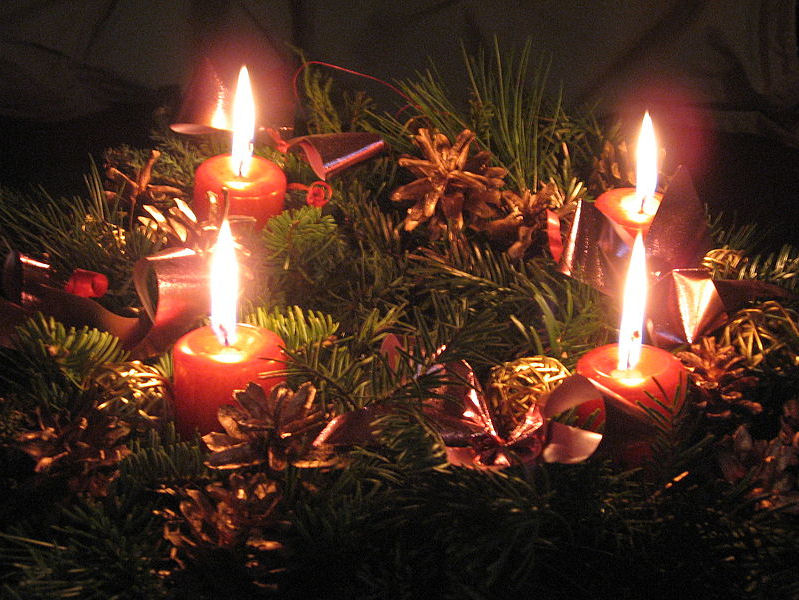
Advent is the beginning of the Western liturgical year, a time of waiting to celebrate the Nativity of Jesus on December 25th.  As the Catholic Encyclopedia notes, it begins on the Sunday closest to the Feast of St. Andrew the Apostle (November 30th) and embraces four Sundays in total.  In any given year, then, it may start as early as November 27th or as late as December 3rd.  This year it began on December 2nd. (At left, a German Advent wreath; picture credit)

But what does this have to do with agriculture?  Quite a bit, actually, for several reasons.  Advent occurs during the darkest time of year, a cold season of long nights and short days. The sun is at its southernmost location vis-a-vis the earth (see right), leaving the northern hemisphere in cold and darkness. Productive farming is almost impossible under such conditions (unless you have a hoophouse like ours, and even then, short day-lengths prohibit the cultivation of many crops).  (Picture credit)

In the pre-modern period, people relied on astronomical events to indicate the proper times for sowing and harvesting, as well as mating and slaughter of animals.  It was never clear how much food had to be stored to get through the winter months, when many people died of starvation.  In early farming settlements (for instance in Neolithic times) people often feared the darkness would never end and the sun never return. Consequently, many pre-Christian religions--for example, in the Roman Empire, northern Europe, North Africa, and the Near and Far East--had sun gods who were honored with rituals (often involving fire ceremonies) to ensure the return of the sun after long winter darkness, and hence the resumption of the agricultural activities that sustained life.

Some Neolithic cultures actually built large stone monuments which most scholars believe functioned as solar calendars, and in which rituals to placate the sun god occurred.  Places like Newgrange in Ireland and Stonehenge in England measured both the shortest and longest days of the year. For instance, Newgrange, an artificial hill with an interior passage, was built to determine the year's shortest day, the Winter Solstice. Winter Solstice occurs around December 21st-22nd; on the Solstice, the sun is at its southernmost location vis-a-vis the earth, leaving the northern hemisphere in cold and darkness.  At Newgrange, on that day, and one or two days before and after, the rising sun shines down an interior passage (see left), striking a ceremonial stone at the passage end.  In this way, the priests who observed this phenomenon knew that afterward, the days would start to lengthen, and the people could begin preparing for another agricultural cycle of life-death-life.  (Picture credit)  Many small farmers today still celebrate the Solstice, both here and in Europe.

To get back to Advent and Christmas.  No one knows when Jesus actually was born. During the Early Christian period, his birth was assigned to different months, but finally, in the 4th century CE, the church decided to assign both a day and a month to his birth, December 25th. Why then?  The Catholic Encyclopedia says the most likely reason is that December 25th was also when Romans celebrated Natalis Invicti, the "birth of the unconquered sun."  Given Jesus' association in Scriptures with the sun and with light in general, it's not surprising the church would settle on this date, coincident with the rebirth of the sun after the shortest day of the year, Winter Solstice.

Early representations of Jesus actually depict him as the sun, for instance in this mosaic (at right) found under St. Peter's in Rome.  (He is shown driving the chariot of the sun across a golden sky, surrounded by grapevines; picture credit).  The Scriptures (both Old and New Testaments) are filled with references, analogies, allegories, and parables about farming, vineyards, growth, birth, death, and rebirth. Agriculture was life and light, just as it still is today.  In Christian theology, Christ is life and light.  And so we wait in the darkness, during Advent, for the birth and rebirth of this God of life, the God of creation, the God of seasons and plants and animals and sun and water.