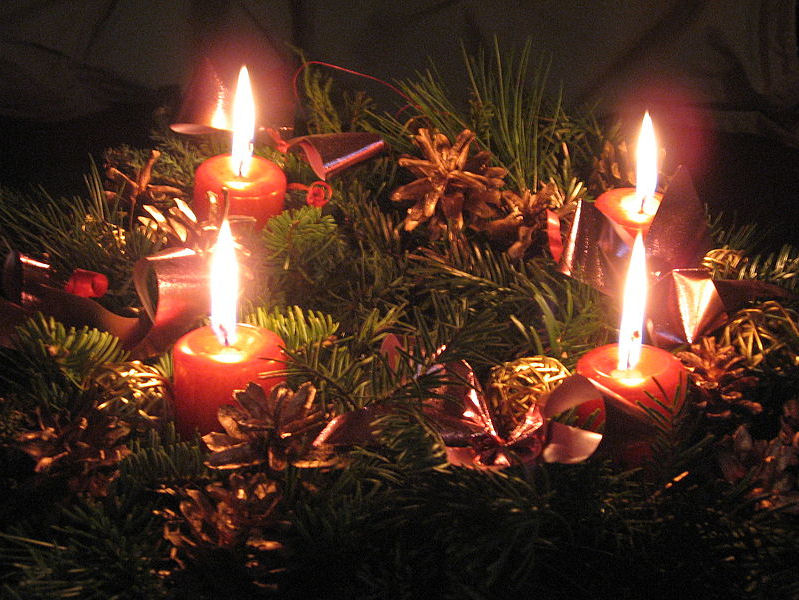
Advent is the beginning of the Western liturgical year, a time of waiting to celebrate the Nativity of Jesus on December 25th.
As the Catholic Encyclopedia notes, it begins on the Sunday closest to the Feast of St. Andrew the Apostle (November 30th) and embraces four Sundays in total. In any given year, then, it may start as early as November 27th or as late as December 3rd. This year it began on December 2nd. (At left, a
German Advent wreath; picture credit)
But what does this have to do with agriculture? Quite a bit, actually, for several reasons. Advent occurs during the darkest time of year, a cold season of long nights and short days. The sun is at its southernmost location vis-a-vis the earth (see right), leaving the northern hemisphere in cold and darkness.
Productive farming is almost impossible under such conditions (unless you have a hoophouse like ours, and even then, short day-lengths prohibit the cultivation of many crops). (
Picture credit)
In the pre-modern period, people relied on astronomical events to indicate the proper times for sowing and harvesting, as well as mating and slaughter of animals. It was never clear how much food had to be stored to get through the winter months, when many people died of starvation. In early farming settlements (for instance in Neolithic times) people often feared the darkness would never end and the sun never return. Consequently, many pre-Christian religions--for example, in the Roman Empire, northern Europe, North Africa, and the Near and Far East--had sun gods who were honored with rituals (often involving fire ceremonies) to ensure the return of the sun after long winter darkness, and hence the resumption of the agricultural activities that sustained life.
Some Neolithic cultures actually built large stone monuments which most scholars believe functioned as solar calendars, and in which rituals to placate the sun god occurred. Places like Newgrange in Ireland and Stonehenge in England measured both the shortest and longest days of the year.
For instance, Newgrange, an artificial hill with an interior passage, was built to determine the year's shortest day, the Winter Solstice.
Winter Solstice occurs around December 21st-22nd; on the Solstice, the sun is at its southernmost location vis-a-vis the earth, leaving the northern hemisphere in cold and darkness. At Newgrange, on that day, and one or two days before and after, the rising sun shines down an interior passage (see left), striking a ceremonial stone at the passage end. In this way, the priests who observed this phenomenon knew that afterward, the days would start to lengthen, and the people could begin preparing for another agricultural cycle of life-death-life. (
Picture credit)
Many small farmers today still celebrate the Solstice, both here and in Europe.
To get back to Advent and Christmas. No one knows when Jesus actually was born. During the Early Christian period, his birth was assigned to different months, but finally, in the 4th century CE, the church decided to assign both a day and a month to his birth, December 25th. Why then?
The Catholic Encyclopedia says the most likely reason is that December 25th was also when Romans celebrated Natalis Invicti, the "birth of the unconquered sun." Given Jesus' association in Scriptures with the sun and with light in general, it's not surprising the church would settle on this date, coincident with the rebirth of the sun after the shortest day of the year, Winter Solstice.
Early representations of Jesus actually depict him as the sun, for instance in this mosaic (at right) found under St. Peter's in Rome. (He is shown driving the chariot of the sun across a golden sky, surrounded by grapevines;
picture credit). The Scriptures (both Old and New Testaments) are filled with references, analogies, allegories, and parables about farming, vineyards, growth, birth, death, and rebirth. Agriculture was life and light, just as it still is today. In Christian theology, Christ is life and light. And so we wait in the darkness, during Advent, for the birth and rebirth of this God of life, the God of creation, the God of seasons and plants and animals and sun and water.