Showing posts with label Persephone. Show all posts

Tuesday, May 14, 2013

Mothers' Day, Mother Earth, and Waging Peace, by Melinda

The antecedents of Mothers' Day are ancient, dating back at least to the Roman holiday, Matronalia, which honored mothers and fertility goddesses--"mother earth" goddesses--like Persephone (see here). Early Jews and Christians celebrated motherhood in various guises, one of the most interesting being the nurturing or feminine side of God:  "'As a mother comforts a child, so will I comfort you,' says the Lord." (Isaiah 66:13). And Matthew (23: 37) famously quotes the parable of Jesus and the Hen:  "'How often have I longed to gather [Jerusalem's] children together, as a hen gathers her chicks under her wings,' Jesus says."  The idea is shown emblematically on the altar of the teardrop-shaped Franciscan church, Dominus Flevit ("God Wept"), in the foothills of the Mount of Olives, and also was depicted in painting, e.g., by Stanley Spencer in the 20th century (click here).
"Jesus & the Hen," Dominus Flevit
Mediaeval Catholics honored Mother Mary on the 4th Sunday of Lent, called "Mothering Sunday." The celebration was linked to Mother Church; everyone was encouraged to visit the Cathedral (Mother Church) in which they grew up.

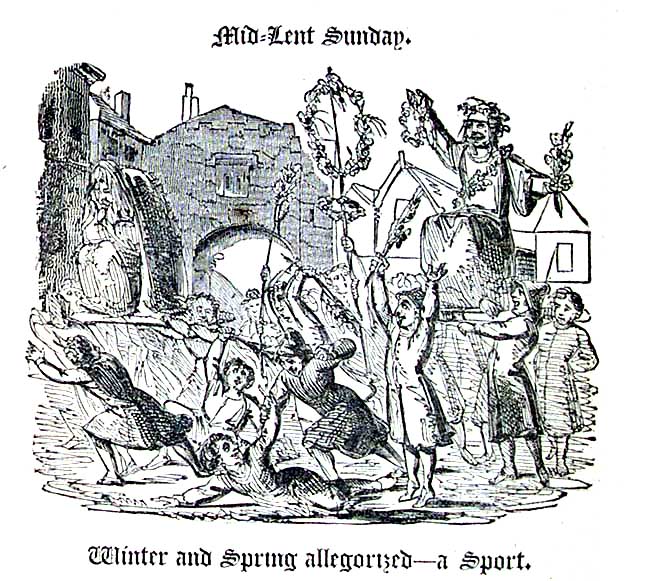
Spring conquering Winter
The agricultural connection returned as the Lenten celebration of Mother Mary expanded to include mothers in general, that is, "going a-mothering" with flowers, cakes and trinkets as gifts. Lent occurred in the springtime in Europe; hence activities grew to include seasonal agricultural celebrations. For instance, young boys paraded with large, straw-filled, clothed effigies of Winter and Spring. In the ensuing mock battle, Spring always vanquished Winter in a celebration of the fertility and new growth of farm crops in the spring. The boys then took food to their own mothers as gifts.

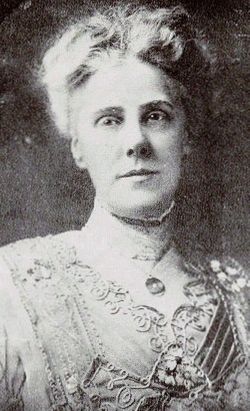
Anna Jarvis
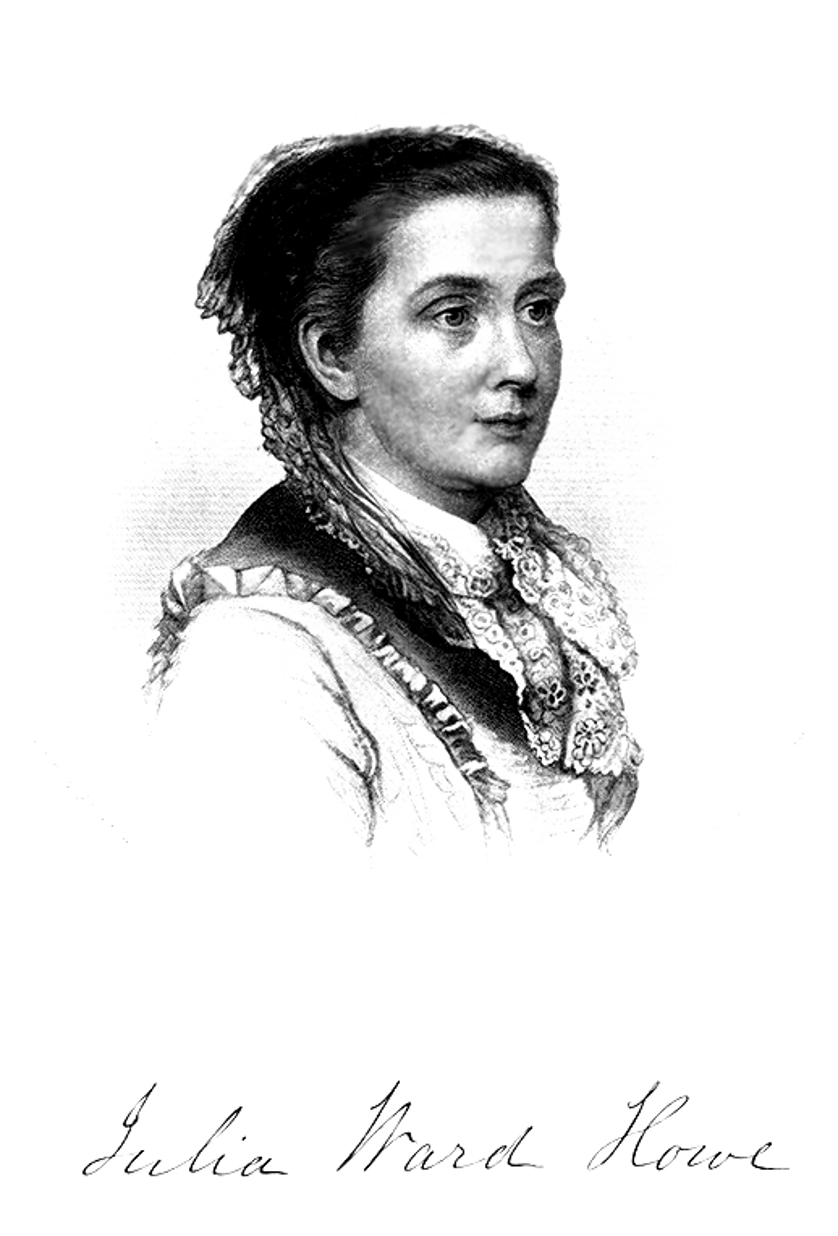
Our modern Mothers' Day is actually political in origin, thanks to the 19th-century feminists/suffragists, Julia Ward Howe and Anna Jarvis.  For them the issues were political (and seem particularly apt for our present day as well).

In 1870, Howe, a pacifist, was struggling to put an end to war, convinced that no mother would willingly send her son to die in battle. In 1872, she declared June 2nd as "Mothers' Day of Peace." By the early 20th century, Anna Jarvis managed to have Mothers' Day recognized as an official holiday (though the date was changed to May). Sadly, Jarvis spent the rest of her life combating the crass commercialism that developed around Mothers' Day, and she eventually died in an asylum.

In our own violent times, when the "great questions" about women--and about "Mother Earth"--again are being raised on various fronts, we would do well to recall a few lines in Julia Ward Howe's politically radical Mothers' Day Proclamation of 1870 (for more click here):

"Arise, then, women of this day.
Arise all women who have hearts, whether your baptism
be that of water or tears.
Say firmly, we will not have great questions decided by
irrelevant agencies.
Our husbands shall not come to us reeking of carnage for
caresses and applause.
Our sons shall not be taken from us to unlearn all that we
have been able to teach them of charity, mercy, and
patience.
We women of one country will be too tender of those of 
another country to allow our sons to be trained to injure
theirs.
From the bosom of the devastated Earth, a voice goes out
with our own.
It says, disarm.  Disarm...."

Friday, March 29, 2013

Easter, Fertility, and Farming, by Melinda

Obviously, for Christians Easter is the most significant holiday of the liturgical year, as it celebrates rebirth, regrowth, new spiritual beginnings, and a new life in the most spectacular fashion.

Crossing over in lunisolar calendar
But there are fascinating historical aspects of Easter that lend it other nuances. For one, it's the only "movable" holiday in the Western liturgical calendar--that is, like almost all Hebrew and Muslim holidays, it's calculated by a lunar or "lunisolar" method, while other Christian holidays have set dates in the Gregorian calendar. Easter 2013, for instance, falls on the first Sunday (31st March) after the first full moon (27th March) after 20th March (the Spring Equinox).  Hence, in any given year it can occur from March 22nd to April  25th; according to one scholar, the year-to-year sequence of Easter dates is so complex that it "takes 5.7 million years to repeat"!

This lunisolar calculation is similar to Jewish Passover or Pesach, which occurs around the same time as Easter and marks the beginning of the harvest season in Israel, as well as celebrating the Jews' release from
bondage into a new life (mirroring the theme of rebirth in Christian Easter). The seven foods that were sacred to the Jews (of which Jesus was one) symbolized the seasons of a year's farming, the Jewish connection to the "good land," and a hoped-for abundant harvest--pomegranates, dates, olives, figs, grapes, and wheat (linked with Passover). Jesus' selection of wheat and grapes (wine) at the last Passover meal to represent an abundant "new life," hence, is symbolically profound both theologically and in terms of the land, the soil.

The Worm Moon
Further, vis-a-vis farming, the March full moon is called the Worm Moon, a name bestowed on it by the Algonquins, as this is when the ground begins to soften and worms with their castings reappear, worm-castings (poop) being one of the richest components of the soil and a sure sign of healthy, fertile, organic soil. That's also why robins are so numerous at this time of year, eating lots of worms in early-morning darkness before they lay their eggs around mid-morning (click here for more). The connection between eggs, the moon, fertility, and the growth of new life is at the heart of much Easter symbolism, if you go back far enough in history.

"Easter," for instance, according to the English monk and Christian writer Bede, was named after "Eostre" or "Ostara," the Saxon dawn-goddess of fertility and new life. Eostre had many goddess-analogues in other cultures, including Aphrodite, Astarte, Ishtar, Hathor, Kali, and Demeter (mother of Persephone; we talked about Persephone's symbolism in farming in an earlier post [click here]).
Eostre

What links these goddesses with both Easter and farming is their association with earth's fertility, fostered through cycles of death/darkness/dirt and life/light/air, both seasonally and liturgically. Kali, for instance, in Hindu culture, was described as "the ground," meaning "the mysterious source of life," "ultimate reality," and "the very soil, all-creating and all-consuming." As farmers and gardeners, we need to revere "the ground"--that is, the soil, the humus, which is the earthly source of life and growth--and we need to understand both its productive and destructive cycles, that life springs from death, which of course is also the idea behind the Easter liturgy.

In their role as progenitors of fertility, these goddesses sometimes were
The hare's decorated egg-gift
symbolized by eggs, which of course are a source of new life
. Our popular custom of giving Easter eggs thus also has ancient roots. As far back as 3000 BCE in ancient Persia, red-dyed eggs were given to mark the start of spring.  But why are our Easter eggs delivered by a rabbit? According to one legend, the goddess Eostre found an injured bird and saved its life by transforming it to a hare (another animal associated with springtime and fertility). But the transformation was incomplete, and the hare retained the bird's ability to lay eggs. To thank Eostre for its life, the hare decorated its eggs, leaving them as gifts for Eostre. The constellation Lepus,which can be seen just south of Orion, is, in fact, Eostre's egg-laying hare! Think of that when you watch our new hens this spring and summer at the Farm!  Think of Eostre's dying bird, reborn as a rabbit!
Constellation Lepus


Thursday, December 27, 2012

Winter Market, Part III: Saturday, December 29th, 2012

The goddess Persephone
This is it, the last Winter Market of 2012, yet with many more to follow in 2013.  We are just so amazingly blessed to have the freshest, most local, totally organic produce possible!  Many thanks to Devorah for the great job she's doing.  And all in the middle of winter, during the so-called "Persephone period," when plants normally are dormant or dead (see here for Devorah's earlier comments on the Persephone period).  Persephone, the ancient goddess of fertility, was abducted by Hades because she was so beautiful; her mother Demeter bargained to get her back, but the bargain involved Persephone returning to the Underworld for three months each year.  That was the ancient Greek explanation for the vegetatively barren winter months.

What we expect to offer in our little "Persephone work-around" hoophouse on the 29th is arugula, carrots, radishes, kale, chard, scallions, cilantro, parsley, lettuce mix, and--just maybe--our first little bit of broccoli!  There are so many wonderful dishes to make with what we have, and some of the recipes can become the basis of 5 or 6 different meals.

Melinda's Winter-Greens and Basil Pesto Sauce--this is truly a laissez-faire recipe. Feel free to substitute ingredients, change amounts to suit your taste, and so forth.

  • 2 to 4 bunches of winter greens of your choice--chard, any sort of kale, bok choi, arugula, radish greens, turnip greens, spinach, dandelion greens, chickweed--and you can use a LOT, because it all becomes much smaller once you pulse it in a food processor (my last batch, which made enough for several pasta meals, included 2 bunches of kale, 1 bunch of radish greens [which are a little spicy], and a bunch of turnip greens)
  • scallions, if you like, roots removed
  • 1-2 tbsp lemon juice
  • 4 or more large garlic cloves, peeled (I use a whole small head, but I'm a garlic freak!)
  • about a cup of nuts of your choice--walnuts, cashews, pine nuts, almonds--or more to taste
  • about a cup of olive oil; more if needed
  • about a cup of pecorino or parmesan cheese (or vegan substitute), or more/less to taste
  • 1 tsp salt (or more/less to taste)
  • (Photo credit)
  • about a half cup dried basil--start with that amount, then add more if you think it's needed
Remove tough stems from kale & discard; if you use chard or bok choi, trim and chop the stems into ~1/2-in. chunks. Start with one bunch of greens, add part of the olive oil and the lemon juice. Whiz in food processor till smooth. Repeat with any other greens you're using, including chopped chard or bok choi stems; for scallions, first chop into ~2-in. lengths, then add. Whiz again till smooth, scraping down sides periodically. (If you want a less caloric pesto, you can substitute plain yogurt or low-fat cottage cheese--or even broth or soy milk--for some of the olive oil, though of course these will alter the flavor of the finished pesto.) Add 1/2 cup dried basil, nuts, garlic, & salt and whiz again. Start adding cheese a quarter cup at a time & taste; keep adding till it suits you! If you think the pesto is too thick, add more oil. Put pesto into jars or zip-type plastic bags and refrigerate or freeze. The flavor develops further as the pesto is stored.

The pesto can be used classically on pasta (adding beans is nice too). Or you can coat roasted or grilled lamb chops or beef steaks with pesto and rewarm them in the oven before serving. Or you can start with a whole chicken, gently loosen the skin with your hands (while nevertheless not removing it), and rub the meat under the skin with pesto sauce (rubbing the interior with lemon juice is nice too); then roast the chicken till done. Pesto sauce can also be mixed into minestrone; it can be used on hoagies or grilled cheese sandwiches or vegetarian wraps. Whatever you do, have fun & eat well!

Wednesday, December 12, 2012

Winter Market II: Lessons Learned, by Devorah Ketai

What a bounty of the most local goodness!
On a practical note, it's been interesting to see the pace at which plants grow, and how much we're able to produce and harvest week by week. Speed of growth during this period is greatly affected by sunlight hours and temperature. According to Eliot Coleman's The Winter Harvest Handbook, we are in the Persephone period, when sunlight is less than ten hours per day. [See here for the myth of the vegetation goddess, Persephone.] Plants grow extremely slowly during this period of time. With regard to temperature, while the plants benefit from a warm day, they are mostly affected by average temperatures. Hence, if the hoophouses reach 80 degrees during the day but drop to 30 degrees at night, they are only experiencing an average temperature of 55 degrees, meaning they won't grow as fast as one would think with 80-degree days!

Burgeoning arugula!
One helpful aspect of winter growing, though (as Eliot Coleman notes), is that once plants have established root systems, they'll grow back quickly after harvesting, even during this period of short days and cold temperatures. This explains why, even though I cut the arugula and braising mix for the first market, it's already almost fully grown for the second! I just seeded some new spinach, however, and what I have learned from Eliot Coleman is that it might take a long time to reach maturity, as it didn't have an established root system before the days shortened. My hope is that we have enough different kinds of plants, with already developed root systems, that we'll have plenty of food to last us through these winter months!