Showing posts with label wheat. Show all posts

Monday, November 11, 2013

Armistice/Veterans' Day, , the "Eleventh Hour," St. Martin of Tours, and Old Agricultural Practices, posted by Melinda

(photo source)
"The eleventh hour...": perhaps you've heard that phrase, as in "Wow, you sure waited till the 11th hour to get *that* done!" The phrase goes back to the Bible (Matthew 20:6, in the parable of the vineyards--click here), but in succeeding millenia, the notion of 11 o'clock, especially on November 11th, took on further meaning. As food blogger/photographer Cynthia Bertelson notes (click here for her blog), it was on the 11th day of the 11th month in 1918 that Marshall Foch declared that all hostilities would cease at 11:00 a.m., French time, and would not resume until further notice. (For her post on Armistice Day and St. Martin of Tours, click here--hers is one of the most beautiful blogs we follow; it's called "Gherkins and Tomatoes," and you'll see it in the blog list at lower left.) About a century earlier, all Prussian serfs also had been freed on November 11th (probably because of the date's connection to both agriculture and religion); Bertelsen lists other military treaties, too, that were signed over the years on November 11th, beginning in 1500 CE.

So what has this to do with St. Martin of Tours and old agricultural observances?  As Bertelson explains, the choice of the 11th hour on the 11th day reveals the Catholic traditions that many of the Allies shared, in particular that November 11th is the Feast Day of St. Martin of Tours, patron saint of soldiers, beggars, vintners, innkeepers, and geese (yes, there's a Martinist story behind the geese, those darn loud-mouths [!], which you can read on Bertelson's post!). The significance of beggars hired to work in the vineyards is clarified if you read all of Chapter 20 in Matthew--see here--e.g., he who is last shall be first, "for many are called but few chosen," a notion that also has been applied at times to soldiers.

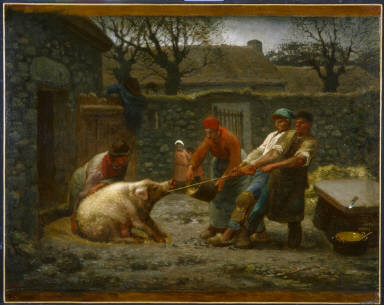
Jean-Francois Millet, Killing the Hog, National
Gallery of Canada, late 1860s (source)
For our purposes, in the context of farming, November 11th--Martinmas--was regarded as the beginning of winter and the day that religious rites connected with Advent began. Martinmas marked the seeding of wheat for the following year, as well as the grape harvest and production of new wine, and the slaughter and preservation of wheat-fattened hogs, calves, geese, and other animals to provide meat over the winter. (The connection to wheat and grapes, of course, has religious overtones, as does the concept of slaughter/sacrifice.)

Many of us don't like to think about such slaughter, but it was a necessity at the time to put food by to get through the lean winter ahead. (The Bible often uses harvest and slaughter as parables for the cycle of life-death-life; even Jesus was not a vegetarian--click here for a Red Hill Root article on the controversy over Jesus' dietary habits; see page 5.) Hence the harvest also was a time of feasting for all (starting at the 11th hour), including beggars and serfs, with goose often featuring in the feast. I have to say, however, that Millet's painting, above, always makes me sad, as pigs and hogs are such intelligent animals, and the hog knows what's coming up (or coming down) for him or her. The children watching in the background are there to reinforce the notion of cyclical life-death-life, as, when they mature, they too will kill the hog.

Finally, the wheat that had been harvested, again reinforcing both pre-Christian and Christian concepts of life-death-life, was baked into bread loaves shaped like humans, as shown in this lovely, atmospheric photograph by Cynthia Bertelsen.
Martinmas bread, photo by Cynthia Bertelsen (source)

Thursday, August 1, 2013

Today, August 1st, is Lammas, the "First Harvest," by Melinda

In older Europe and North America, temperatures were colder on average than they are today, and August 1st was the traditional day for harvesting "first fruits," including grains.  Lammas (according to a lunar calendar) marked the end of summer, though it may not feel like that nowadays! It may have originated in an earlier Celtic holiday called Lughnasadh, an agriculture-based fertility rite commemorating the seasonal passing of the god of light, Lugh (equivalent to Dionysos in ancient Greece or Apollo in Rome). Lammas celebrated the first harvest, as it was vital to a community to put away enough food, as the day-lengths shortened, to tide them over the winter.
First Harvest Fruits (source)

By mediaeval times, Lammas had been incorporated into the calendar of Christian church holidays. It also has affiliations with the Jewish harvest holiday, Sukkot, though the dates of Sukkot vary from year to year in the Jewish calendar.

In the Christian church, Lammas is translated as "Loaf Mass"; it was celebrated with loaves of bread made from the first harvested grains. These special loaves of bread were taken to the local church and placed on the altar for blessing and as thanks for a good harvest. Indeed, Lughnasadh or Lammas is celebrated even today in some churches interested in Celtic spirituality, like All Saints Brookline, an Episcopal church near Boston (click here for their excellent history of the holiday). Indeed, as they note, in Ireland, Lammas was the traditional day for harvesting the first potatoes, so consider our Blue potatoes a tribute to Lammas!
Celtic Lammas emblem, All Saints Brookline

Popularly, Lammas was a time for feasting and games, with artists, Morris dancers, and town fairs. It also was celebrated by the creation of "corn dollies" ("corn" was the word used for what today would be wheat, barley, or rye). They were based on the popular belief that the spirit of the grain could shelter in the corn dolly over the winter, and then be plowed back into the ground in the spring to ensure another good harvest.
Corn Dollies of various sorts
(British tea towel I own)
The final Lammas tradition was making barley beer, as in the British folksong "John Barleycorn," about the suffering and death of the grain as it was processed, only to be revivified in a new form in the Lammas ale. For a version of "John Barleycorn Must Die" by the group Steeleye Span, click here.
Lammas Ale, Vancouver (source)

Thursday, May 2, 2013

Our New Baker, Jerry Sheehan, by Melinda

Wow, have we got a great addition to our off-farm offerings this year--fresh-baked, artisanal breads made as much as possible from locally sourced, organic ingredients.  Their estimable baker is Jerry Sheehan, who will be offering samples at the Open House and Plant Sale (see here) on May 11th, and then selling to us through the season.
Wheat harvest, Tacuinum Sanitatis, 1400s

Among Jerry's offerings are French baguettes, Raisin-Walnut Whole Wheat bread, Bavarian pretzels, NY deli-style rye bread (using whole dark rye flour), peasant bread (whole wheat & whole rye with sourdough), French country white (with sesame seeds and sourdough), Italian focaccia and ciabatta (oh, be still my beating heart!), American-style pullman sandwich loaves (with whole wheat & organic honey), and organic 8-grain pullman sandwich loaves. (For the origin of pullman bread, click here.)

The top-of-the-line ingredients Jerry uses include a range of flours from King Arthur Flour, a Vermont-based company founded in 1790--see here for more about King Arthur products and issues of social and environmental responsibility.

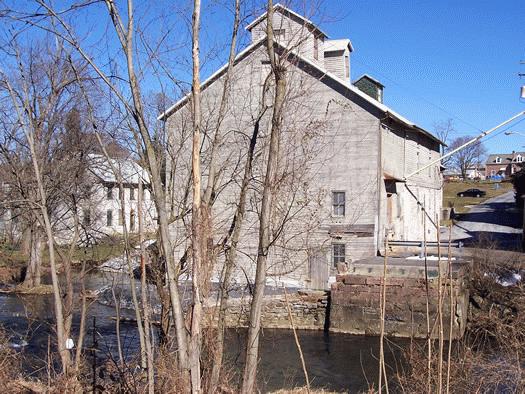
Annville Mill, Lebanon Co., PA,Daisy Organic Flours
As well, Jerry sources more locally from Daisy Organic Flours in Lebanon County, just north of Lancaster, producer of 100% organic wheat, spelt, and all-purpose whole wheat flours. Daisy Flours' Annville Mill dates back to earlier than 1740 and is the oldest continually running flour mill in the U.S.  Back in those days, Pennsylvania was one of the country's breadbaskets, an identity that was eventually undermined by the completion of the Erie Canal, which made it cheaper to buy grains from the midwest and ship them back east.  Daisy Flour and its Annville Mill are among the shining exceptions to that corporatized, "bottom-line" mentality. For Daisy Organic Flours, see here.  For the history of the Annville Mill, click here.

Among Jerry's other ingredients are organic Montana-grown rye berries milled here, organic raw honey from Lancaster County, and grey sea salt from France.  All of his sourdough breads use sourdough starter that Jerry cultivates, while a straight dry yeast is used in the baguettes, ciabatta, and focaccia breads.

Jerry's own background is fascinating. He grew up in Delaware County; studied at St. Joe's; lived & worked in Germany for three years; traveled extensively in Germany, Spain, France, England, & Ireland;  & lived & worked in Mexico for almost three years. During much of this time he was in international accounting and finance. Then, about 4 years ago, he had an epiphany, taking up the creation of Euro-style artisanal breads and American rustic desserts like deep-dish apple pie. Jerry's altogether a Renaissance man, and we're lucky to have him as our baker. We can't *wait* to taste some of these scrumptious-sounding breads!

Friday, March 29, 2013

Easter, Fertility, and Farming, by Melinda

Obviously, for Christians Easter is the most significant holiday of the liturgical year, as it celebrates rebirth, regrowth, new spiritual beginnings, and a new life in the most spectacular fashion.

Crossing over in lunisolar calendar
But there are fascinating historical aspects of Easter that lend it other nuances. For one, it's the only "movable" holiday in the Western liturgical calendar--that is, like almost all Hebrew and Muslim holidays, it's calculated by a lunar or "lunisolar" method, while other Christian holidays have set dates in the Gregorian calendar. Easter 2013, for instance, falls on the first Sunday (31st March) after the first full moon (27th March) after 20th March (the Spring Equinox).  Hence, in any given year it can occur from March 22nd to April  25th; according to one scholar, the year-to-year sequence of Easter dates is so complex that it "takes 5.7 million years to repeat"!

This lunisolar calculation is similar to Jewish Passover or Pesach, which occurs around the same time as Easter and marks the beginning of the harvest season in Israel, as well as celebrating the Jews' release from
bondage into a new life (mirroring the theme of rebirth in Christian Easter). The seven foods that were sacred to the Jews (of which Jesus was one) symbolized the seasons of a year's farming, the Jewish connection to the "good land," and a hoped-for abundant harvest--pomegranates, dates, olives, figs, grapes, and wheat (linked with Passover). Jesus' selection of wheat and grapes (wine) at the last Passover meal to represent an abundant "new life," hence, is symbolically profound both theologically and in terms of the land, the soil.

The Worm Moon
Further, vis-a-vis farming, the March full moon is called the Worm Moon, a name bestowed on it by the Algonquins, as this is when the ground begins to soften and worms with their castings reappear, worm-castings (poop) being one of the richest components of the soil and a sure sign of healthy, fertile, organic soil. That's also why robins are so numerous at this time of year, eating lots of worms in early-morning darkness before they lay their eggs around mid-morning (click here for more). The connection between eggs, the moon, fertility, and the growth of new life is at the heart of much Easter symbolism, if you go back far enough in history.

"Easter," for instance, according to the English monk and Christian writer Bede, was named after "Eostre" or "Ostara," the Saxon dawn-goddess of fertility and new life. Eostre had many goddess-analogues in other cultures, including Aphrodite, Astarte, Ishtar, Hathor, Kali, and Demeter (mother of Persephone; we talked about Persephone's symbolism in farming in an earlier post [click here]).
Eostre

What links these goddesses with both Easter and farming is their association with earth's fertility, fostered through cycles of death/darkness/dirt and life/light/air, both seasonally and liturgically. Kali, for instance, in Hindu culture, was described as "the ground," meaning "the mysterious source of life," "ultimate reality," and "the very soil, all-creating and all-consuming." As farmers and gardeners, we need to revere "the ground"--that is, the soil, the humus, which is the earthly source of life and growth--and we need to understand both its productive and destructive cycles, that life springs from death, which of course is also the idea behind the Easter liturgy.

In their role as progenitors of fertility, these goddesses sometimes were
The hare's decorated egg-gift
symbolized by eggs, which of course are a source of new life
. Our popular custom of giving Easter eggs thus also has ancient roots. As far back as 3000 BCE in ancient Persia, red-dyed eggs were given to mark the start of spring.  But why are our Easter eggs delivered by a rabbit? According to one legend, the goddess Eostre found an injured bird and saved its life by transforming it to a hare (another animal associated with springtime and fertility). But the transformation was incomplete, and the hare retained the bird's ability to lay eggs. To thank Eostre for its life, the hare decorated its eggs, leaving them as gifts for Eostre. The constellation Lepus,which can be seen just south of Orion, is, in fact, Eostre's egg-laying hare! Think of that when you watch our new hens this spring and summer at the Farm!  Think of Eostre's dying bird, reborn as a rabbit!
Constellation Lepus