Thursday, May 2, 2013

Our New Baker, Jerry Sheehan, by Melinda

Wow, have we got a great addition to our off-farm offerings this year--fresh-baked, artisanal breads made as much as possible from locally sourced, organic ingredients.  Their estimable baker is Jerry Sheehan, who will be offering samples at the Open House and Plant Sale (see here) on May 11th, and then selling to us through the season.
Wheat harvest, Tacuinum Sanitatis, 1400s

Among Jerry's offerings are French baguettes, Raisin-Walnut Whole Wheat bread, Bavarian pretzels, NY deli-style rye bread (using whole dark rye flour), peasant bread (whole wheat & whole rye with sourdough), French country white (with sesame seeds and sourdough), Italian focaccia and ciabatta (oh, be still my beating heart!), American-style pullman sandwich loaves (with whole wheat & organic honey), and organic 8-grain pullman sandwich loaves. (For the origin of pullman bread, click here.)

The top-of-the-line ingredients Jerry uses include a range of flours from King Arthur Flour, a Vermont-based company founded in 1790--see here for more about King Arthur products and issues of social and environmental responsibility.

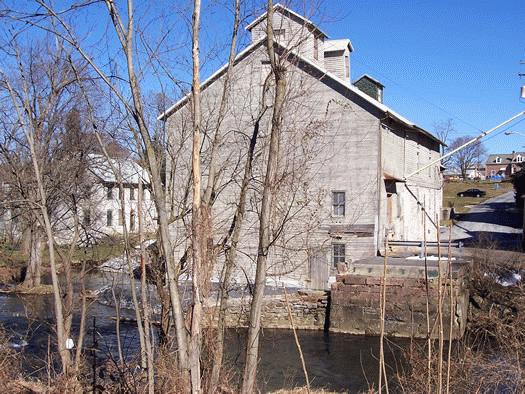
Annville Mill, Lebanon Co., PA,Daisy Organic Flours
As well, Jerry sources more locally from Daisy Organic Flours in Lebanon County, just north of Lancaster, producer of 100% organic wheat, spelt, and all-purpose whole wheat flours. Daisy Flours' Annville Mill dates back to earlier than 1740 and is the oldest continually running flour mill in the U.S.  Back in those days, Pennsylvania was one of the country's breadbaskets, an identity that was eventually undermined by the completion of the Erie Canal, which made it cheaper to buy grains from the midwest and ship them back east.  Daisy Flour and its Annville Mill are among the shining exceptions to that corporatized, "bottom-line" mentality. For Daisy Organic Flours, see here.  For the history of the Annville Mill, click here.

Among Jerry's other ingredients are organic Montana-grown rye berries milled here, organic raw honey from Lancaster County, and grey sea salt from France.  All of his sourdough breads use sourdough starter that Jerry cultivates, while a straight dry yeast is used in the baguettes, ciabatta, and focaccia breads.

Jerry's own background is fascinating. He grew up in Delaware County; studied at St. Joe's; lived & worked in Germany for three years; traveled extensively in Germany, Spain, France, England, & Ireland;  & lived & worked in Mexico for almost three years. During much of this time he was in international accounting and finance. Then, about 4 years ago, he had an epiphany, taking up the creation of Euro-style artisanal breads and American rustic desserts like deep-dish apple pie. Jerry's altogether a Renaissance man, and we're lucky to have him as our baker. We can't *wait* to taste some of these scrumptious-sounding breads!

Tuesday, April 30, 2013

Red Hill Farm Open House & Plant Sale, by Joanne

Flyer by Joanne
We're having our annual Open House and Plant Sale--all are welcome--on Saturday, May 11th, from 1 pm to 4, rain or shine!  This is your opportunity to become acquainted with all the aspects of the farm, as well as meet Farm Manager Angela and other farmers and staff (our beekeeper and our Purple Martin consultant), sample our off-farm products and meet the vendors, and discover the latest addition to our offerings, artisanal breads made from locally grown grains by Jerry Sheehan (see the post just above this one for more information on the breads and their maker).

We will have well marked parking areas for the event--just follow the signs on South Convent Road; you'll be parking across the street from the main convent, then walking from there over to the farm (not a long walk).

If you plan on attending (these are always a lot of fun!), please RSVP by calling or emailing Joanne Rosenbaum, our events coordinator (610-558-5396 or Jrosenbaum@osfphila.org).  See you there!  Buy a few organic plants (or a lot!) for your home garden, or as a nice Mother's Day gift!

Thursday, April 25, 2013

Dodging Raindrops, by Angela

From "Gode Cookery"
We love our taters!
My spring farm ambitions resemble a Thanksgiving plate filled on an empty stomach. New establishments of rainwater collection, berry-trellising, chickens, asparagus plants, strawberry plants... all in addition to the regular pre-season CSA preparations. Somehow the funnel of life condensed the climax of these projects into this week as we file the remaining zoning paperwork for the chickens with the township; welcome local handymen to raise gutters to the barn; and embark upon the planting extravaganza of 1000 asparagus plants, 600 strawberry plants, and about 1500 seed potatoes!

I have tunnel vision on the windows of weather, between the bouts of rain when the sky is not dripping and the fields are dry enough to prepare with a tractor.  It's a race or rather game of cleverness--or so I tell myself--to successfully dodge the raindrops and stay two steps ahead of the plants in the greenhouse and those scheduled to arrive.

Angela up early to catch the sun
Farming requires the flexibility of readiness when weather permits, which at this time of year seldom completely falls within the Monday through Friday schedule. For the most part, during my years of training I apprenticed under farmers who lived on their farms, and now I more fully understand the perks of their situations.

Red Hill Farm has been teaching me how to project overnight lows, so as to close up the greenhouse, as well as the efficiency of shifting priorities when the weather allows while I am on the farm. I don't live far away, but enough to make it worth my while to stay an extra hour to do tractor work in the sunshine and then sleep with ease as the evening rains arrive, knowing I've set the stage for our preparations to continue on schedule.
To the rain, I say "Bring it".... We're ready, best as best can be, taking a big bite off the plate of spring ambitions.  Oh, I smile to think of how delighted I am to share the steadily growing farm with the members in just a wee bit over a month.

Tuesday, April 16, 2013

Jerusalem Artichokes, aka Sunchokes, by Melinda

Jerusalem artichokes, also called Sunchokes, are sold in some specialty markets, but we'll have some fresh from the ground and grown organically by a Farm member.  This plant is in the sunflower family, producing flowers that look like small sunflowers and smell like chocolate!

The edible part, however, is the underground tubers, which look a little bit like potatoes but have a texture rather like a water chestnut, kind of crisp and crunchy.  They can be eaten raw or cooked.  Either way, you want to scrub them well (an unused toothbrush works well to get into crevices), break off any sprouts or shoots, though you do NOT have to peel them.  Some chokes have a reddish, indented end on them--that's where they were attached to the mother plant, so you can just cut that end off.  Then slice, dice, saute, whatever--you can even shred and dry them in a dehydrator for later use in salads, soups, stews, stir-fry, or other recipes.
Sunchoke tubers in all shapes/sizes


Roasted Sunchokes

  • 2 or 3 large sunchokes (or the equivalent in smaller chokes), scrubbed, peeled & sliced 1/4 in. thick
  • 2 tbsp olive oil
  • 1/2 tsp salt
  • 1 sprig fresh rosemary
  • 3 or 4 garlic cloves, peeled but left whole
Preheat oven to 425. Add sunchoke slices & garlic to roasting pan with olive oil & toss till chokes and pan bottom are coated with oil. Add more oil as necessary, till most everything is coated. Sprinkle with salt and rosemary. Bake for 15-20 min., till sunchokes are a bit browned and are tender on the inside like a potato. For more Sunchoke recipes, click here and here.
Roasted Sunchokes
By the way, you also can save some of the raw sunchokes, break them into pieces that each have an eye or sprout on them, and plant them, either in a large heavy container, or in the ground.  They can get quite tall, so putting them against a wall or fence is helpful.  As well, they do spread over the years, unless you have them in containers, which makes it easier to control them.

Saturday April 20th--the Last Winter Market for This Year, by Angela

Our hoophouses are still booming with produce from our Winter Markets, and I invite all of you to one last market this Saturday, April 20th, from 10:00 am to 12:00 pm.
To those of you who are unfamiliar, this is not part of the CSA but is how we sell produce in the off season from the CSA, so it is set up like a market for you to purchase what you would like.

This Saturday, we'll have butterhead lettuces, salad mix, arugula, kale, and radishes.

There also will be Jerusalem artichokes (aka Sunchokes) grown organically by a Farm member.

Wednesday, April 10, 2013

A Slight Chicken Glitch, by Angela

Our chickens' arrival has been postponed in order to meet all township requirements and to further ready their new home. There is no concrete date right now. Just wanted to keep you informed.